
US11617316B2: Apparatus and Methods for a Hydroponics System with Enhanced Heat Transfer
This patent, granted on April 4, 2023, focuses on integrating efficient heat management into hydroponic systems, particularly by using the circulating nutrient solution to cool LED grow lights.
It was filed on November 9, 2018, by inventor James S. Ray, Jr., and is assigned to him as an individual. The core innovation addresses the challenges of heat buildup in indoor farming setups, where artificial lights like LEDs generate excess thermal energy that can damage plants, reduce light efficiency, or require bulky cooling systems like fans and heat sinks. By recycling this heat through the hydroponic fluid, the system cuts energy costs, simplifies design, and optimizes space for stacked or arrayed growing configurations.
Key Problem Solved
In conventional hydroponics, grow lights produce significant heat (e.g., from LEDs or metal halide lamps), necessitating separate cooling mechanisms that increase operational complexity, energy use, and costs. Overheating can limit light intensity (e.g., by restricting drive currents to prevent damage), waste energy, and complicate environmental control in enclosed spaces like vertical farms. This patent solves these issues by turning the nutrient solution into a dual-purpose coolant, eliminating the need for additional hardware while repurposing waste heat to warm the solution if beneficial for plant growth.
How the Invention Works
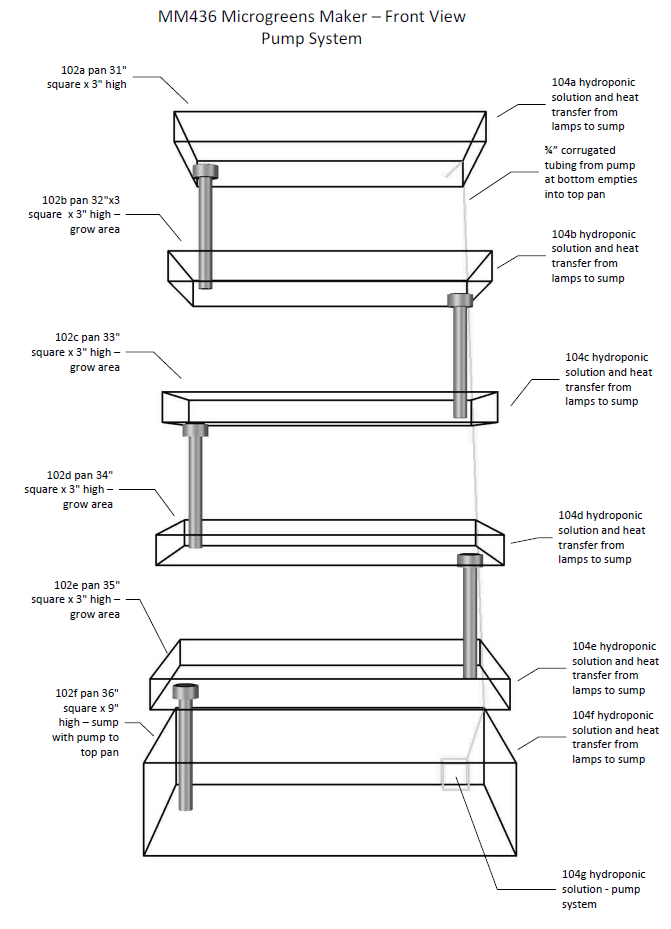
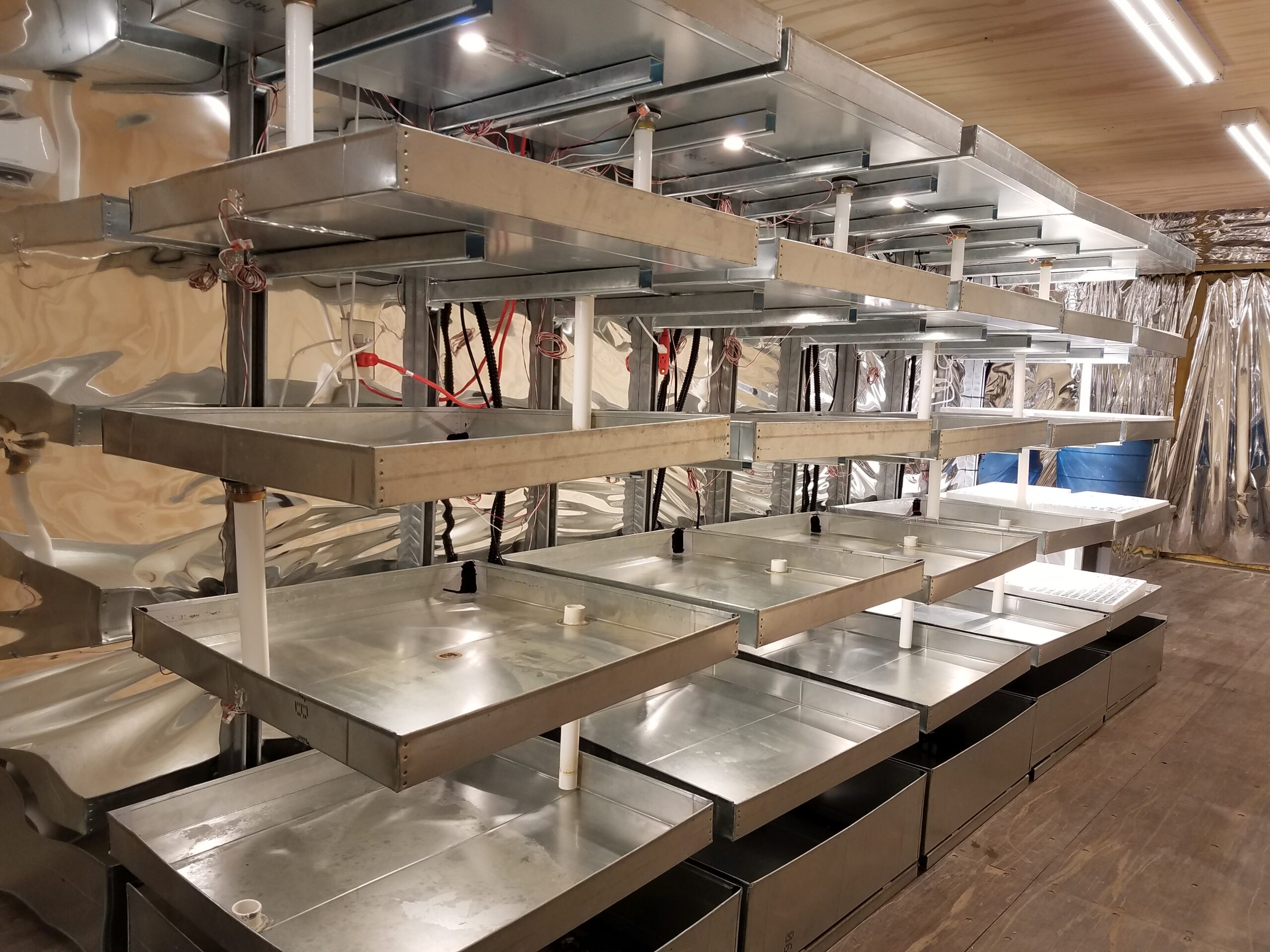
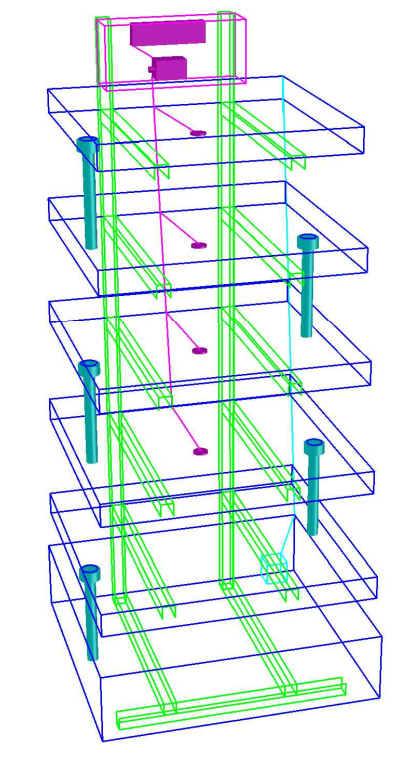
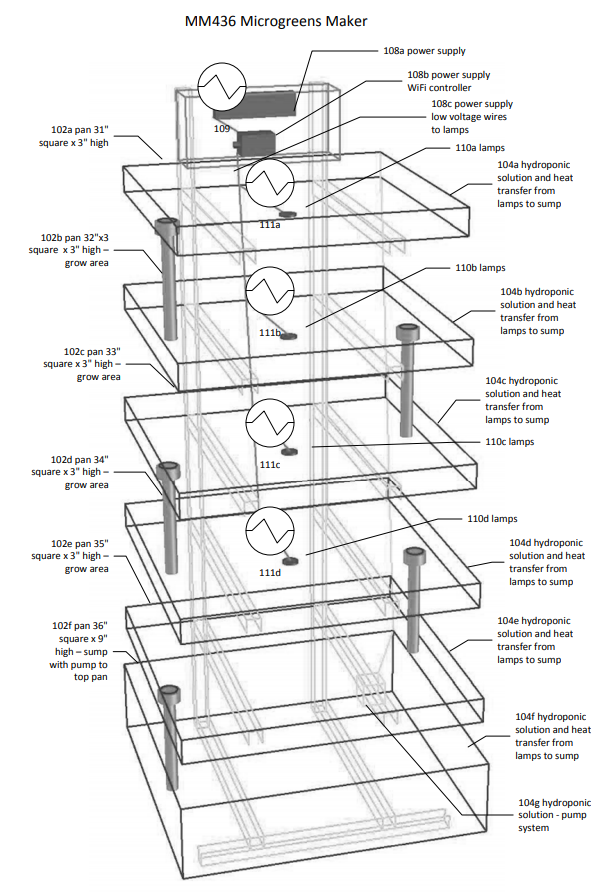
The system consists of multiple hydroponic pans (trays) made from thermally conductive materials like aluminum or steel, arranged in vertical stacks or horizontal arrays. A nutrient-rich grow solution (e.g., water with minerals) is pumped through these pans in a series flow pattern:
- The solution starts at a bottom “pump pan” or reservoir.
- It’s pumped up to the top pan via tubes.
- In each pan, the solution flows across the tray (e.g., from one end to the opposite end in a serpentine or unidirectional path), absorbing heat.
- It then drains downward to the next pan, repeating the process until returning to the pump for recirculation.
LED lights are directly attached to the exterior bottom surface of each pan using thermal adhesives (e.g., grease, paste, epoxy, or tape) without any intervening chassis or housing. This direct thermal coupling allows heat from the LEDs to conduct through the pan’s material into the circulating solution, cooling the lights to near-ambient temperatures (e.g., below 25°C). The solution acts as a heat sink, dissipating thermal energy as it moves, which prevents hotspots and enables higher LED drive currents (e.g., up to 2.1A) for brighter, more efficient illumination with fewer lights needed overall.
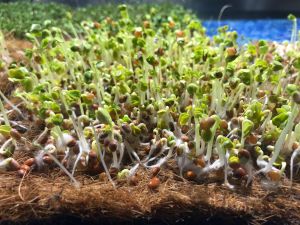
Pans can be stacked (e.g., 3 or more in a column) to save vertical space, with adjacent stacks forming arrays separated by small gaps (e.g., less than 3 inches) to allow airflow channels. This setup promotes ventilation, shares light between pans, and can include barriers (e.g., plastic sheets) for clean zones to prevent contamination. The flow can be continuous or pulsed (e.g., ebb-and-flow cycles every 30 minutes for 12 hours), adjusting solution depth (e.g., 0.5-1.5 inches) to suit plant roots or media like cocoa weave mats for microgreens.
A power supply and controller manage the system:
- The power supply converts AC to DC and drives the LEDs via constant-current drivers using pulse-width modulation (PWM).
- The controller monitors and adjusts parameters like light intensity, wavelength, temperature, pH, electrical conductivity (EC), and humidity using integrated sensors.
- It supports remote operation via apps and can use digital signal processing (DSP) for precise spectrum control.
This integrated approach recycles heat as useful energy, reduces HVAC demands, and enhances overall system efficiency for controlled-environment agriculture.
Key Features: Cooling of LED Lighting with the Hydroponic Solution
- Direct Thermal Integration: LEDs are fixed at the solution level on the pan’s underside, ensuring heat transfers efficiently via conduction (LED → thermal adhesive → pan → solution). This maintains low case temperatures, extending LED lifespan (e.g., 50,000+ hours) and allowing cost savings by using fewer, higher-powered lights.
- Series Flow for Enhanced Heat Transfer: The unidirectional flow across each pan maximizes contact time and surface area for heat absorption, with drains positioned oppositely to intakes to prevent stagnation and promote mixing.
- Material Choices: High-conductivity metals like aluminum ensure rapid heat dissipation; no fans or specialized sinks are required, simplifying manufacturing and reducing noise.
- Light Spectrum Capabilities: While primarily focused on heat, the system supports quantum LEDs for custom wavelengths outside standard PAR (400-700 nm), such as UV-B at 285 nm or far-red at 760 nm, to boost photosynthesis without phosphor-based heating.
- Scalability and Modularity: Arrays allow expansion; overlapping light from adjacent pans minimizes waste, and zoned controls enable tailored environments.
Relevant Claims
The patent includes 34 claims, with key ones emphasizing the cooling mechanism:
- Claim 1: Defines the core system with heat-conductive pans, series drainage, and LEDs thermally coupled to pan exteriors for direct heat transfer to the solution.
- Claim 3: Adds the pump and recirculation loop to cool lights to ambient levels.
- Claim 5: Integrates a controller for measuring and adjusting light parameters like intensity.
- Claim 10: Allows individual control of multiple lights with sensors for feedback.
- Claim 12: Specifies quantum LEDs for targeted wavelengths, including UV-B (285 nm) and far-red (760 nm).
- Claim 15: Enables separate control of wavelength and intensity over time for subsets of lights.
- Claim 17: Supports per-light adjustments across durations.
- Method Claims (e.g., Implied in 27): Outline pumping, circulating, and draining the solution to achieve cooling.
This patent builds a foundation for energy-efficient hydroponics by merging lighting and cooling into a single, fluid-based system.
US12349638B2: Apparatus and Methods for a Hydroponics System with Light Control
Granted on July 8, 2025, this patent extends hydroponic innovations by emphasizing programmable, multi-wavelength lighting tailored to plant life cycles, spanning 285 nm to 760 nm. It was filed on April 3, 2023, by inventor James S. Ray, Jr. (the same as the previous patent), and is assigned to him individually. As a continuation of earlier filings (priority back to November 10, 2017), it builds on heat management concepts but shifts focus to dynamic light optimization, addressing inefficiencies in spectrum delivery that waste energy and limit plant yields in indoor setups.
Key Problem Solved
Standard grow lights often provide fixed or broad spectra (e.g., white light from phosphor-coated LEDs), leading to energy waste, excess heat, and suboptimal growth across plant stages (e.g., too much blue light during flowering). This can reduce photosynthesis efficiency, increase costs (lighting is often the biggest expense in urban farming), and require manual adjustments. The patent solves this with closed-loop, programmable control that delivers precise photons only when needed, integrating with hydroponics for feedback-driven adjustments while incorporating safety and natural light features.
How the Invention Works
Similar to the prior patent, the system uses stacked or arrayed hydroponic pans with a circulating grow solution in series flow: pumped from a reservoir, through pans via tubes, absorbing heat/nutrients, and draining back. Lights (LEDs) are thermally attached to pan undersides for cooling via the solution, but the emphasis is on advanced control.
The controller (e.g., a processor like Raspberry Pi with memory and DSP capabilities) uses sensors (e.g., quantum light meters at the plant canopy) to measure incident light spectra. It applies algorithms (e.g., Fourier transforms or FFT) to analyze data, compare against programmed targets, and adjust outputs in real-time via LED drivers (e.g., PWM or dimmers). This creates a closed-loop feedback system: detect fluorescence or photosynthesis peaks (e.g., via 285 nm excitation), then tweak wavelengths/intensities to optimize. Power supplies handle multiple channels for different colors, enabling independent control.
The setup supports modular housing with openable panels (e.g., hinged ceilings) for natural sunlight integration, supplemented by artificial lights to maintain consistent cycles (e.g., 18 hours/day). Solar panels on panels provide auxiliary power. Safety features detect human presence (e.g., door sensors) to cut UV and switch to safe green light.
Key Features: Programming of Lights Across Plant Life Cycles for Wavelengths 285 nm to 760 nm
- Dynamic Spectrum Adjustment: Lights are programmed to vary over time (e.g., daily cycles or full lifecycles like vegetation to flowering). Wavelengths cover UV (285 nm for yield boosts via photomorphogenesis), blue (460 nm for chlorophyll), green (560 nm), red (660 nm for flowering), and far-red (760 nm for shade avoidance). Mixtures create custom “recipes” (e.g., increase UV in flowering for 20% higher yields).
- Closed-Loop Feedback: Sensors measure per-wavelength PPFD (photosynthetic photon flux density, e.g., 200-1000 μmol/m²/s); algorithms adjust for targets, using quantum LEDs for efficient, bandgap-specific photons without phosphor heat.
- Individual Light Control: Subsets or single LEDs adjust independently (e.g., via separate drivers or potentiometers), allowing fine-tuning (e.g., boost far-red during 10-hour flowering phases).
- Integration with Cooling: Builds on thermal coupling to maintain efficiency, with solution circulation enhancing overall system stability.
- Additional Enhancements: Remote app control, video monitoring, multi-parameter sensors (temp, pH), and natural light blending for energy savings.
Relevant Claims
Out of 20 claims, highlights include:
- Claim 1: Core system with multi-wavelength lights on pans, canopy sensors, and controller for time-based intensity/wavelength adjustments to maintain targets across lifecycles.
- Claim 2: Adds Fourier-based controller with LED drivers.
- Claim 4: Quantum sensors for PPFD/efficiency control.
- Claim 7-8: Separate intensity/wavelength control per source/subset over time.
- Claim 10: Quantum LEDs for custom spectra.
- Claim 11-12: Includes UV (<400 nm) and far-red (>700 nm).
- Claim 14: Multiple power supplies with feedback.
- Claim 17: Housing for natural light.
- Claim 19: UV cutoff and green light on detection.
- Claim 20: FFT for bandgap photon optimization.
This patent advances precision agriculture by making lighting adaptive and efficient, complementing the heat-transfer focus of US11617316B2 for comprehensive hydroponic solutions.